
 Marketplace
How accessible is the Wiesn? A Munich resident in a wheelchair shares his experiences and offers tips on beer tents, rides and the best way to get there.
- 7 Minutes of reading time
- 17 September 2026
- Frieda Laura
When brass band music rings out through the streets of Munich, the scent of roasted almonds hangs in the air and dirndls and lederhosen dominate the cityscape, it’s that time of year again: the Wiesn is about to begin. The name ‘Wiesn’ refers to the Theresienwiese, where the Oktoberfest has been held since 1810.
With the traditional cry of ‘O’zapft is!’ – Bavarian for ‘It’s tapped’ – Munich’s current mayor will open the Oktoberfest this coming Saturday. The world’s largest folk festival attracts millions of people from all over the world every year. It captivates with its blend of tradition, joie de vivre and conviviality.
This short video (in German) provides an insight into accessibility at the Wiesn. It highlights disability-friendly measures such as reserved seating areas in beer tents, ramps at shooting galleries and special gondolas on the Ferris wheel.
What is Oktoberfest like for people in wheelchairs or with reduced mobility? With dense crowds, loud music and packed beer tents, a visit to the festival can quickly become challenging. The City of Munich emphasises on its ‘Accessible Wiesn’ website that, as the organiser, it is committed to ensuring a straightforward and enjoyable visit. But just how inclusive is the Wiesn really?
For this blog article, I spoke to Dennis Bruder. He lives with a high level of paraplegia, uses an electric wheelchair and has been visiting the Wiesn for many years.
The Wiesn from a wheelchair user’s perspective
Dennis used to visit the Oktoberfest three or four times a year. Since the coronavirus pandemic, he has been going there less often, partly due to changes in his circumstances. In 2025, he visited once and as part of an official visit by the Pfennigparade Foundation, during which he tested the accessibility of the Oktoberfest alongside three other staff members.
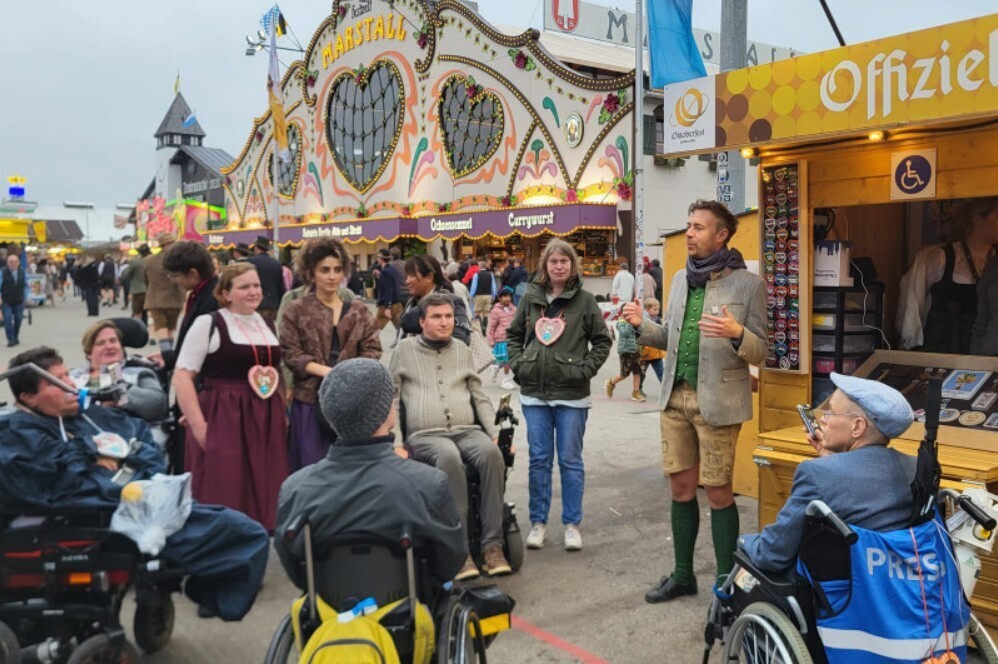
Dennis Bruder and other staff from Pfennigparade during the Wiesn check. (Image source: https://www.pfennigparade.de/)
Dennis's earliest memories of Oktoberfest date back to before his accident. Even as a child, he loved the rides and the food; later, he came to love the festival tents and the party atmosphere. For him, the Wiesn is above all about meeting people, a sense of light-heartedness and taking a break from everyday life. The exuberant atmosphere helps him to clear his head. However, the hustle and bustle can also be stressful, especially when it’s crowded.
There’s one thing he notices every year that always makes him smile: at the Wiesn, people suddenly become particularly open, approachable and talkative – no doubt partly because of the alcohol. Dennis enjoys starting conversations with people he would never meet in his day-to-day life. Sometimes he wishes this openness would last beyond the Wiesn.
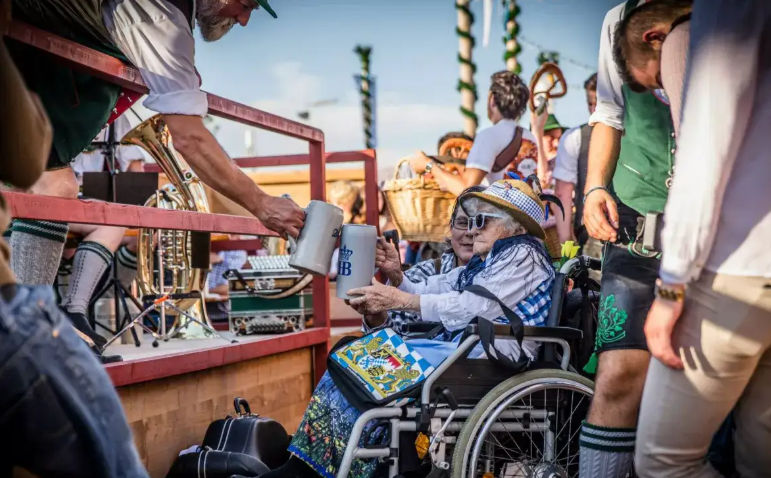
At the Munich Oktoberfest, people with and without wheelchairs should be able to celebrate together. (Image source: https://www.muenchen.de/, photo: Exithamster)
Well prepared for Oktoberfest
Dennis advises against travelling by car. Although transport services and accessible taxis are available, there are not enough of them. Public transport is a more reliable option. Munich’s underground system is now largely accessible, with small ramps on many platforms. For the journey to the Wiesn, Dennis recommends getting off at Goetheplatz station on lines U3 and U6 rather than at Theresienwiese station. From there, it is a more relaxing walk to the festival grounds as there are far fewer crowds.
Anyone travelling by car can find free disabled parking spaces in the south of Theresienwiese. The Swiss 'Parking Card for Disabled People' in light blue is accepted; a standard disability or IV card is not sufficient.
Good preparation can make a visit much easier. Lift breakdowns, crowded paths and suddenly blocked access points can complicate a planned route at short notice. It is therefore worth checking the journey in advance, for example by looking up public transport connections and checking the status of escalators and lifts on the underground (website available also in English). Where possible, planning alternative routes is also advisable. Detailed information on accessibility at Oktoberfest is available on the Oktoberfest website and in the 'Barrier-free Wiesn' blog.
Celebrating at the Wiesn in a wheelchair
The large beer tents and festival venues either have ground-level access or ramps. There are also designated seating areas for wheelchair users in the smaller tents. Wiesn venue operators are obliged to provide suitable seating. During the week, these seats are kept free until 5 pm, at weekends and on public holidays, they are kept free until 2 pm, and no booking is required. However, if a tent is closed due to overcrowding, wheelchair users will only be admitted if they have a reservation. Anyone hoping for a spontaneous seat in a beer tent should therefore arrive early. Further information on accessible entrances and wheelchair spaces in the festival tents can be found (in German only) on the Munich city portal.

Seats are available for wheelchair users in the Wiesn tents. (Image source: https://www.oktoberfest.de/, photo: RAW, Stefan Dohl)
However, the designated wheelchair spaces are not everyone’s first choice. Dennis, for example, is reluctant to use them because they are usually located on the periphery. He prefers a seat at the end of a table in the main aisles. Dennis describes his experience as follows:
“I enjoy being around people, so I think it's discriminatory that people with disabilities must sit at the edge. Of course, there are safety considerations and escape routes need to be kept clear. However, I try to avoid sitting in the designated seats and instead sit in the regular aisles at the end of the tables. This works quite well in some tents where the aisles are wider, such as at the Bräurosl or at the Oide Wiesn. In others, it’s hardly possible if the aisles are narrow. In the end, whether you are allowed to sit there also depends on the goodwill of the waiting staff and security personnel.”
Another challenge is the dense crowds at the Wiesn, particularly in the evenings and at weekends. Drunk people can endanger wheelchair users if they stumble. Dennis recounts an incident in which two men were arguing and fell on top of him in the ensuing scuffle. A friend managed to pull him away just in time.
One particularly important aspect of visiting the Wiesn is the “beer return”. All the large festival halls and most of the smaller tents have accessible toilets which can be opened with a Eurokey. There are also seven additional disabled toilets on the festival grounds.
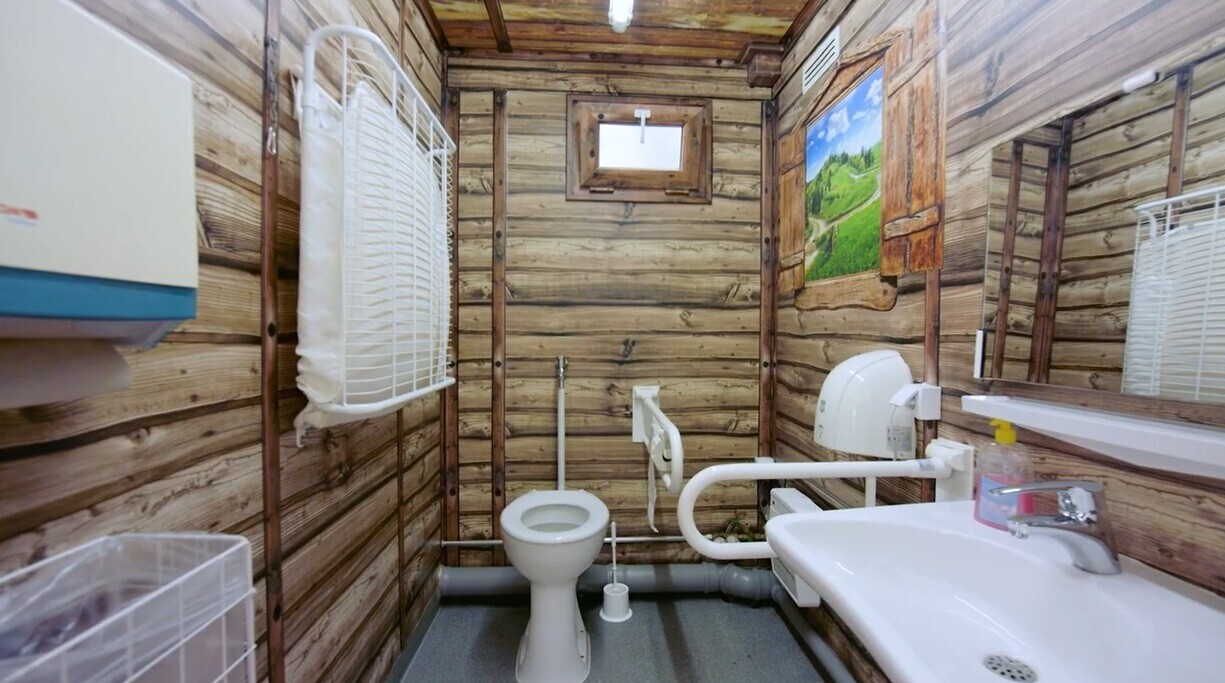
An accessible toilet with 'Hüttenzauber' decorations at the Oktoberfest. (Image source: scene from the YouTube video «Münchner Oktoberfest - Volksfestspaß barrierefrei»)
Where accessibility at Oktoberfest reaches its limits
The existing accessibility services make it easier for wheelchair users to visit the Wiesn. For Dennis, the Wiesn still remains a fantastic event. However, his experiences demonstrate that accessibility encompasses more than just ramps and toilets. Narrow passages, crowds, and inaccessible fairground rides make a visit exhausting. Visiting demands a great deal of courage and energy from Dennis. He explains:
“I use an electric wheelchair, and the only ride I've really been on since my accident is the Ferris wheel, as it's accessible even with an electric wheelchair. Since then, I’ve noticed lots of ramps on other rides, but I can’t imagine using them. With my high-level paraplegia, I simply don’t have enough stability for that.”
Practical tips for visiting the Wiesn
Dennis has six practial tips for people with reduced mobility who are visiting the Wiesn for the first time:
- Avoid weekends: The tents get very crowded, and it's difficult to get a seat.
- Come at lunchtime: It’s easier to find a table during the week. Visitor numbers increase significantly from the afternoon onwards.
- Use beer gardens: When the weather is nice, they’re a good alternative to the festival tents. They’re more spacious and usually good accessible.
- Visit the Oide Wiesn (Old Wiesn): Although there’s an entrance fee, it’s much quieter and more traditional. The tents are more spacious and offer more room to move around.
- Travel by public transport: Access via Goetheplatz station is more relaxed and less crowded.
- Bring a companion: Wheelchair users can easily be overlooked in crowds. A companion can help navigate the crowds, find a seat, and react quickly in critical situations.
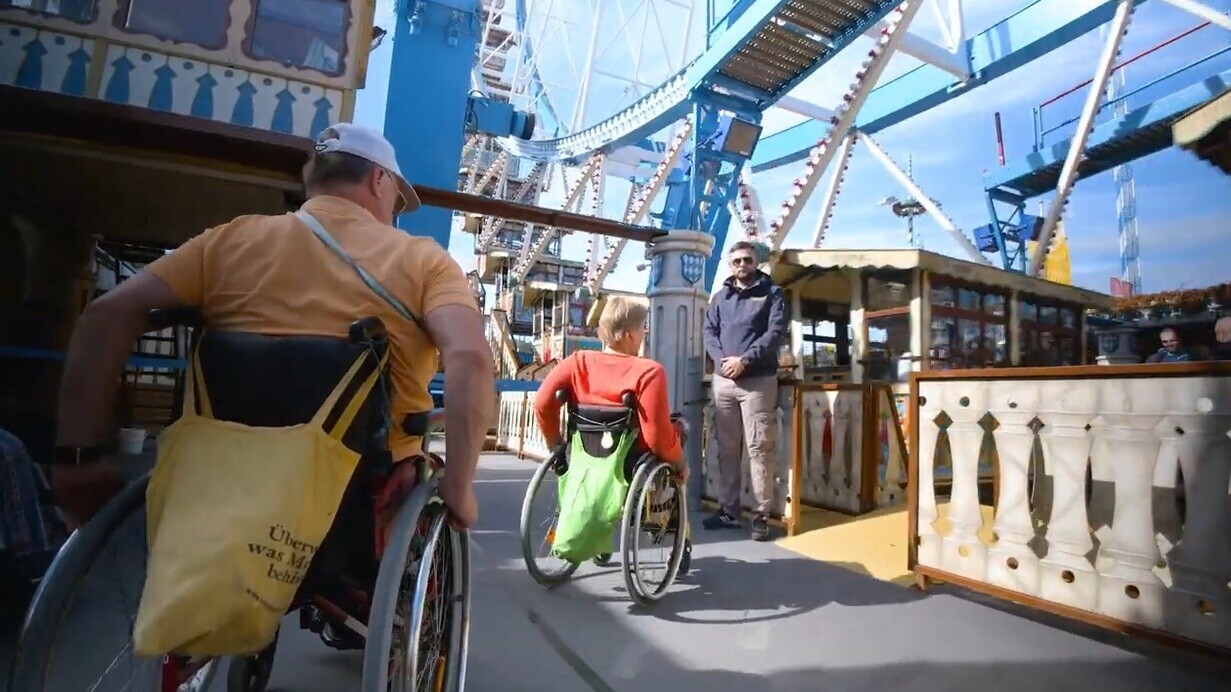
The large Ferris wheel at the Wiesn has two accessible gondolas with wide entrances. (Image source: scene from the YouTube video «Münchner Oktoberfest - Volksfestspaß barrierefrei»)
What's new at Oktoberfest 2026?
This year’s Oktoberfest features several new accessibility improvements:
- Street 4 has been made accessible. Following the renovation of Streets 1 to 3 in previous years, Street 4 was redesigned in 2026.
- Further rides are now accessible. In addition to the Ferris wheel, the Sky Lift and Nostalgia Ghost Train also offer accessible rides. Furthermore, the bumper car attractions Distel, Bayern-Crash, Skooter Zone and the two-post bumper cars are equipped with ramps and vehicles featuring hand-operated throttle controls.
- The Armbrustschützenzelt now has shorter benches. Wheelchair users can now sit right next to other guests, rather than being confined to the edges.
- Wheelchairs can now be reserved online. Two wheelchairs are available free of charge at each luggage storage point near the main entrance (G1) and in the southern section (G10), in exchange for a deposit in the form of a photo ID. Reservations can be made online at de or by phone at +49 176 43831566.
- The 'Hidden Disabilities Sunflower' is now available on the festival grounds. This lanyard features a yellow sunflower on a green background and is available for the first time from the official information stands and the museum tent at the Oide Wiesn.
- There are free drinking fountains at ten locations. The fountains are wheelchair accessible. Visitors must bring their own shatterproof drinking vessels.
Have any of you been to Oktoberfest? If so, do you have more tips for an accessible visit to the Wiesn? We would love to hear about your experiences!


